
gynecology
Endometriosis: Symptoms, Diagnosis, and Treatment
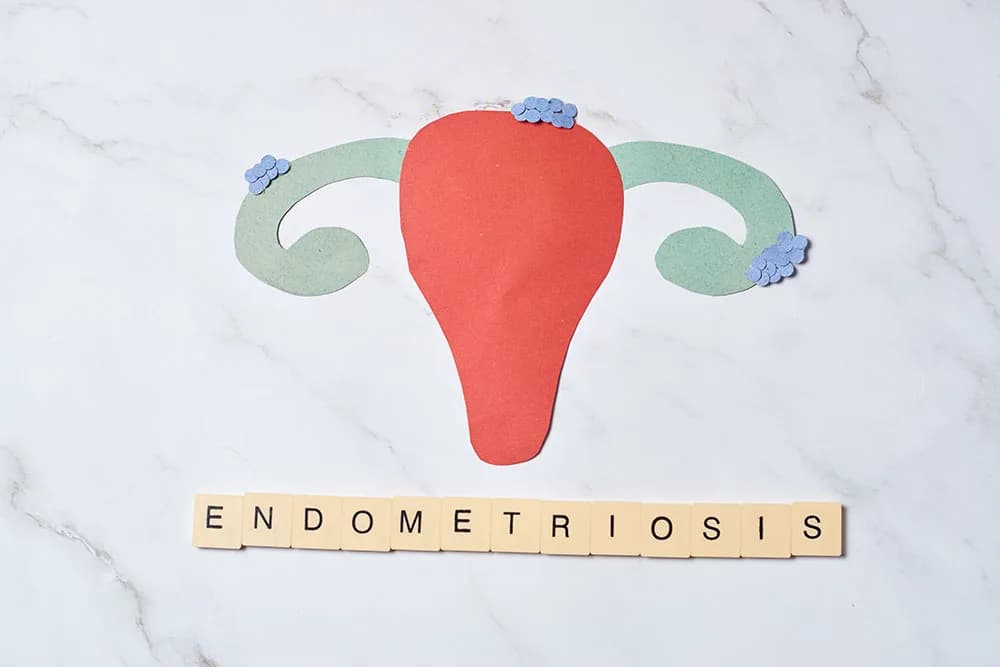
Endometriosis is a condition in which tissue similar to the uterine lining grows outside the uterus — on the ovaries, fallopian tubes, the peritoneum, the bowel, and the bladder. It affects roughly 1 in 10 women of reproductive age.
It responds to the hormonal cycle much as the uterine lining does: it builds up and breaks down. But unlike menstrual blood, it has nowhere to go. The result is chronic inflammation, scarring, and adhesions that can bind organs together.
The diagnostic delay
Endometriosis takes an average of 7 to 10 years to diagnose. That is the defining feature of this condition, and it is worth naming plainly, because the delay is not random. It happens because severe period pain gets normalised — by patients who have nothing to compare it to, and by clinicians who treat it as unremarkable.
Periods should not stop you living your life. Pain that keeps you off work or school, that over-the-counter painkillers do not touch, or that requires you to plan your month around it, is not something to endure quietly.
If you have raised this before and were dismissed, raise it again. Being told "period pain is normal" is not an evaluation.
Symptoms
- Severe menstrual pain, often starting a day or two before bleeding
- Chronic pelvic pain outside your period
- Pain during or after sex, often felt deep rather than at the entrance
- Painful bowel movements or urination, characteristically worse during your period
- Bowel symptoms — bloating, diarrhoea, constipation, nausea, often misdiagnosed as IBS for years
- Heavy or irregular bleeding
- Difficulty conceiving — endometriosis is found in a substantial proportion of people investigated for infertility, and is sometimes the first sign
- Fatigue that is disproportionate and persistent
Symptom severity does not track disease stage. Extensive disease can be nearly silent; minimal disease can be debilitating. This is why "your scan looks fine" does not rule it out.
How it differs from PMS
These are confused constantly, including in older content on this site.
PMS occurs in the luteal phase, in the roughly two weeks before your period, and resolves within a few days of bleeding starting. It is predominantly mood, bloating, breast tenderness, and irritability, tied to the hormonal shift after ovulation.
Endometriosis pain is predominantly during your period and often outside it entirely, is progressive rather than cyclical-and-resolving, and involves pain with sex, bowel movements, or urination — which PMS does not.
If your dominant symptom is mood change in the two weeks before your period, that is PMS or PMDD, not endometriosis. If your dominant symptom is pain that peaks with bleeding, think endometriosis.
How it is diagnosed
- History — the most important part, and where the diagnosis is usually first suspected.
- Pelvic examination — may find tenderness, nodularity, or a fixed uterus. A normal exam does not exclude it.
- Transvaginal ultrasound — detects endometriomas (ovarian cysts of endometriosis) and deep infiltrating disease in experienced hands. It frequently misses superficial peritoneal disease.
- MRI — for mapping deep disease before surgery.
- Laparoscopy with biopsy — historically the definitive diagnosis, and still the reference standard.
Important shift in practice: guidelines no longer require surgical confirmation before treating. Empirical medical treatment based on symptoms is appropriate, and waiting for a laparoscopy is a major contributor to the diagnostic delay. You do not need surgery to begin getting help.
There is no blood test for endometriosis. CA-125 is not a diagnostic test for it.
Treatment
Treatment is aimed at pain, at fertility, or at both — and those goals pull in different directions, so it matters which one you are treating.
Pain
- NSAIDs — started before pain peaks, not after.
- Combined hormonal contraception — continuously, skipping the placebo week, so there is no withdrawal bleed. Often the first-line approach.
- Progestogens — oral, injectable, or the levonorgestrel IUD, which is effective and works locally.
- GnRH agonists and antagonists — induce a temporary low-estrogen state. Effective but with menopausal side effects and bone density loss, so they are given with add-back hormone therapy and for limited duration.
- Pelvic floor physiotherapy — genuinely useful, because chronic pelvic pain drives secondary muscle dysfunction that persists after the endometriosis is treated.
- Pain management input — for established central sensitisation, which is common after years of untreated pain.
Surgery
- Laparoscopic excision or ablation of endometriotic lesions. Excision is generally preferred for deep disease.
- Endometrioma removal — balanced against the fact that ovarian surgery reduces ovarian reserve, which matters if you want to conceive.
- Hysterectomy with or without removal of the ovaries — not a guaranteed cure, because disease outside the uterus remains unless it is excised at the same time. This is an important point that is often not explained.
Fertility
Endometriosis does not mean you cannot conceive. Many people do so without assistance. Where it is a factor, options include surgical treatment and assisted reproduction; the right sequence depends on your age, ovarian reserve, and the extent of disease. This is a conversation to have early rather than after years of trying.
Talk to us
If your periods are controlling your life, that is a reason to be evaluated — not a reason to be told it is normal.
Medical disclaimer
This article is general health information, not medical advice for any individual. Endometriosis needs individual evaluation, and treatment depends on your symptoms, your age, and whether you are trying to conceive. Sudden severe pelvic pain with faintness needs emergency assessment — ovarian torsion and ruptured cysts are surgical emergencies.